
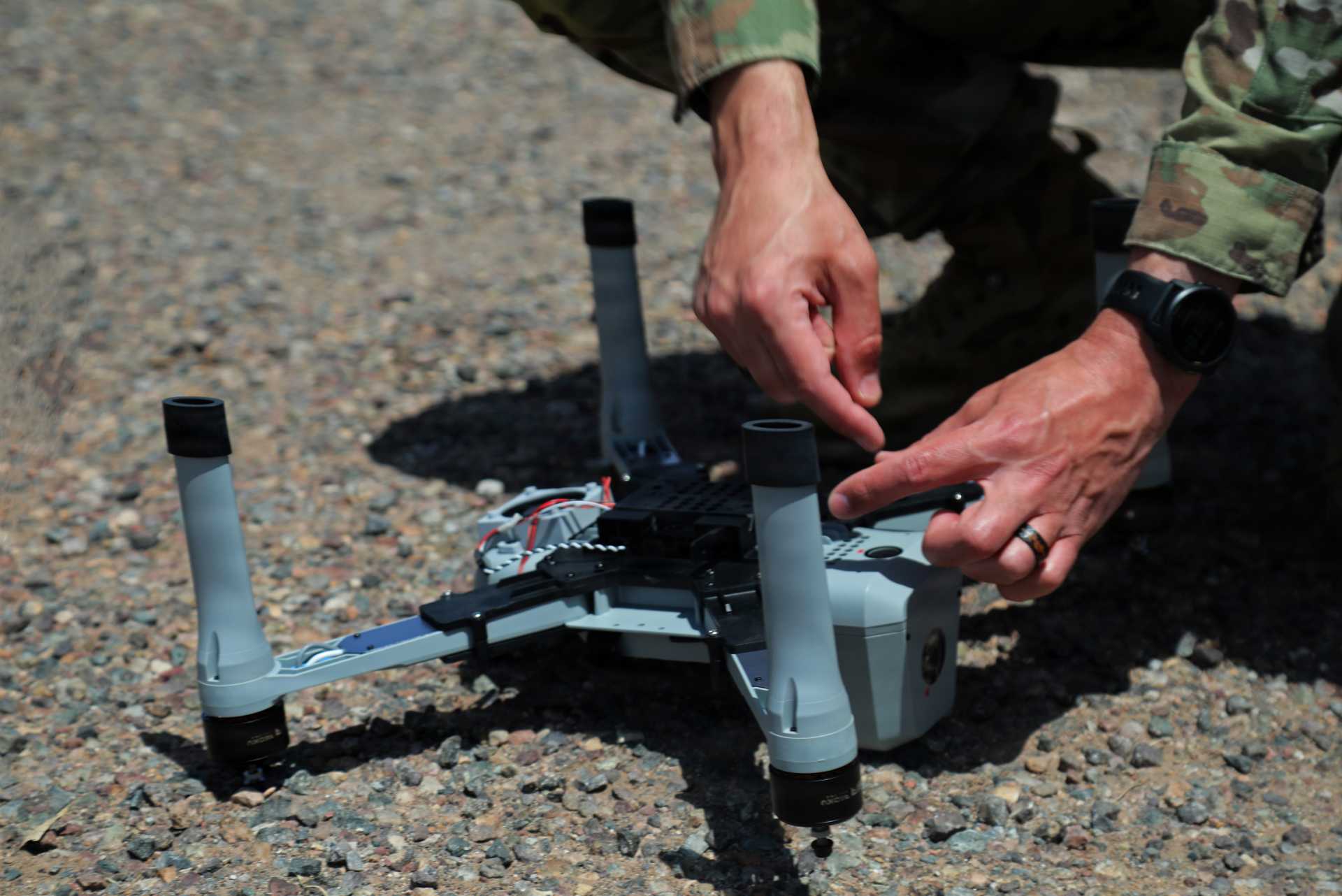
U.S. Army forces are testing the new Bumblebee counter-drone system during African Lion 26 in Morocco as Pentagon planners accelerate efforts to protect troops and military bases against the growing threat posed by low-cost first-person-view (FPV) attack drones that have reshaped modern warfare in Ukraine. The compact anti-drone system is being evaluated as the U.S. Army studies how inexpensive unmanned aerial threats used by Russia, Iran-backed groups, and potentially China could overwhelm conventional air defense systems and threaten armored formations, logistics hubs, and forward operating bases.
According to information published by the U.S. Army on May 15, 2026, American soldiers trained with the Bumblebee system during the multinational African Lion 26 exercise organized by U.S. Africa Command. The exercise is increasingly being used as a live experimentation environment for emerging counter-drone technologies, autonomous battlefield capabilities, and expeditionary force protection concepts designed for future high-intensity conflicts.
The operational relevance of compact counter-drone systems has expanded dramatically since the Russia-Ukraine war demonstrated how inexpensive FPV (First Person View) drones can destroy multimillion-dollar armored vehicles, artillery systems, and supply convoys. Battlefield footage from Ukraine has shown that small, commercially derived drones equipped with explosive payloads can bypass traditional battlefield protection measures, forcing militaries to rethink survivability, maneuver doctrine, and short-range air defense architecture.
For the Pentagon and the U.S. Army, the proliferation of cheap attack drones is no longer viewed as a regional irregular warfare problem but as a strategic global threat capable of targeting U.S. military infrastructure across multiple theaters. U.S. military planners increasingly warn that adversaries could replicate Ukraine-style mass drone attacks against American forces operating in Europe, the Indo-Pacific, and the Middle East, particularly against temporary expeditionary bases with limited layered air defense coverage.
Unlike larger fixed-site counter-UAS systems primarily designed to protect airbases and critical infrastructure, the Bumblebee system appears optimized for maneuver warfare and mobile combat formations. U.S. Army instructors described the system as a portable, first-person-view-capable interceptor capable of conducting intelligence, surveillance, and reconnaissance missions while also supporting payload delivery and strike operations. The ability to control multiple unmanned aerial vehicles from a single ground control station provides tactical units with greater flexibility during distributed combat operations.
The deployment of the Bumblebee counter-drone system during African Lion 26 reflects the broader U.S. Army shift toward integrating affordable attritable systems directly into frontline combat formations. Rather than relying exclusively on high-cost missile interceptors or centralized air defense networks, the U.S. Army is increasingly exploring scalable counter-drone technologies capable of operating at brigade and battalion levels against mass low-cost aerial threats.