
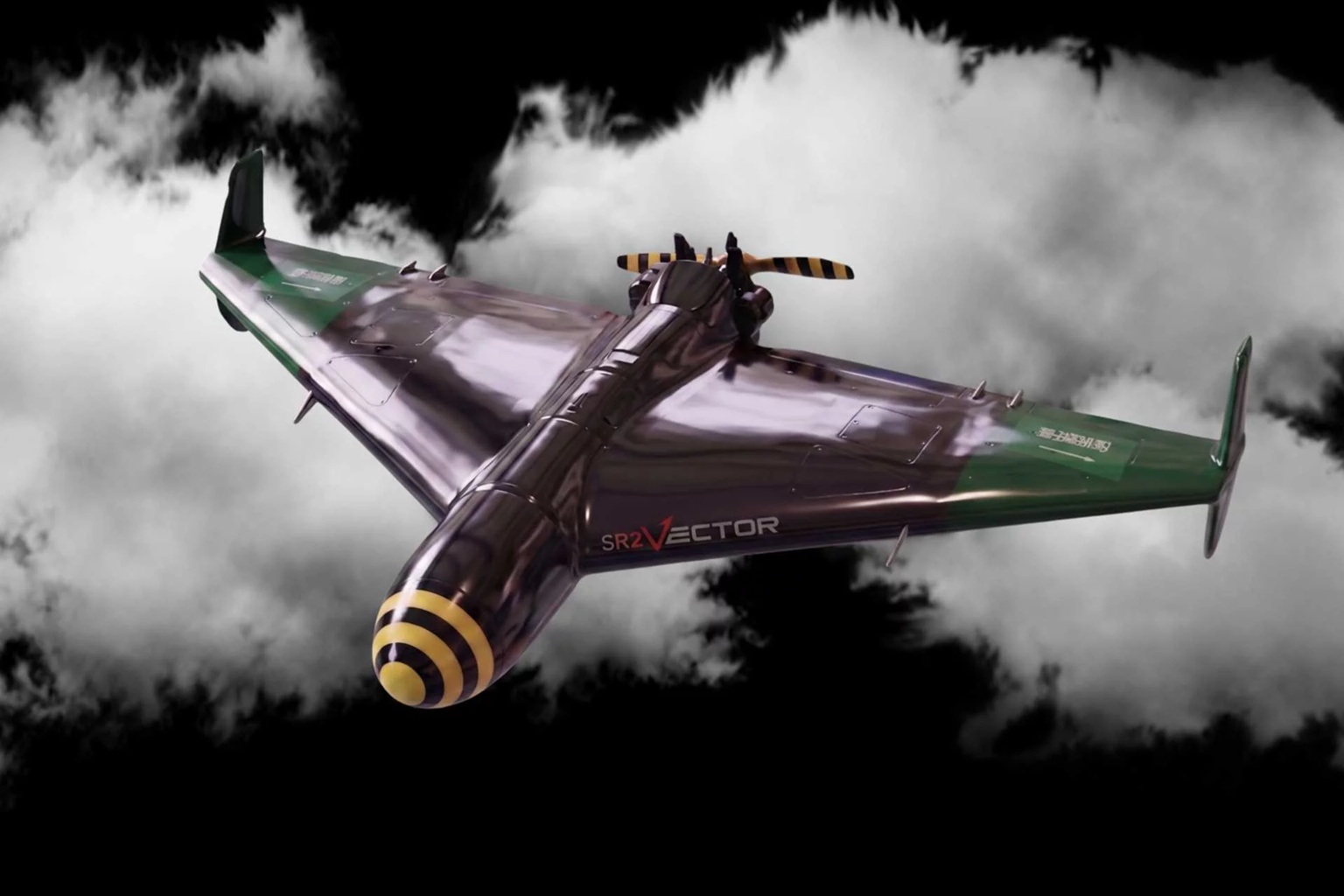
Saudi Arabia has moved to build its own industrial-scale fleet of long-range one-way attack drones as the U.S.-Saudi joint venture SR2Vector began constructing a production facility near Riyadh for the SkyWasp UAV, according to Semafor on May 25, 2026. The program signals a major shift in Gulf military planning toward sustained attrition warfare and mass drone strike capability, giving Riyadh a domestically produced platform designed to overwhelm air defenses and maintain pressure on critical infrastructure during prolonged regional conflict.
The SkyWasp mirrors the operational logic of Iran’s Shahed-136 with a 1,500 km strike radius, low-cost delta-wing design, and simplified navigation architecture optimized for large-scale saturation attacks rather than precision penetration missions. Its emergence reflects a broader global trend in which states increasingly prioritize expendable drones with scalable wartime production capacity to exhaust interceptor inventories, sustain operational tempo, and impose long-term economic pressure on adversaries through persistent infrastructure strikes.
On May 25, 2026, Semafor announced that the U.S.-Saudi company SR2Vector started the construction of a drone production facility near Riyadh for the SkyWasp one-way attack drone, establishing Saudi Arabia’s first domestic program focused on serial production of expendable long-range strike UAVs. The joint venture combines Utah-based Vector and Saudi company SR2 Defense Systems under a localized manufacturing structure integrating U.S.-origin UAV engineering with Saudi industrial infrastructure, financing, and sustainment. Reminding the Iranian Shahed-136 drone, the SkyWasp has a strike radius of 1,500 km, sufficient to reach Tehran, Bushehr, Bandar Abbas, and western Iranian military infrastructure from Saudi territory.
The announcement followed the 2026 Iranian strikes on Arab countries, during which Iran launched thousands of Shahed drones and missiles against Gulf airports, energy terminals, logistics hubs, radar systems, military facilities, hotels, and data centers. Although interception rates remained high, the attacks forced continuous radar coverage, permanent interceptor readiness, and dispersed infrastructure protection across Gulf states. Saudi military planning, therefore, increasingly appears focused on prolonged infrastructure attrition campaigns driven by industrial-scale drone production and repeated strike waves rather than short-duration conventional air operations.
The industrial framework of SR2Vector was formalized during World Defense Show 2026 in Riyadh, when Vector CEO Andy Yakulis and SR2 Defense Systems CEO Idris Alzakari signed a memorandum covering localized assembly, manufacturing, sustainment, operational integration, and supply chain development. SR2Vector later became the dedicated structure responsible for the SkyWasp production and export activity. Financing is being provided through MASNA Ventures, a Saudi defense investment structure linked to SR2 leadership that is targeting a fund exceeding $100 million. The Riyadh-area facility is intended for sustained serial output supporting both Saudi procurement and exports to allied Gulf states.
Unlike previous Saudi localization programs centered on maintenance infrastructure, licensed assembly, and sustainment contracts, the SkyWasp focuses on sovereign production capacity within the strategic strike category. The objective is to establish scalable wartime manufacturing able to replenish inventories during prolonged regional conflict rather than relying on imported systems and externally controlled logistics networks. The SkyWasp drone uses a delta-wing airframe with a rear-mounted pusher propeller configuration closely matching the Iranian Shahed-136 and Russian Geran-2.