
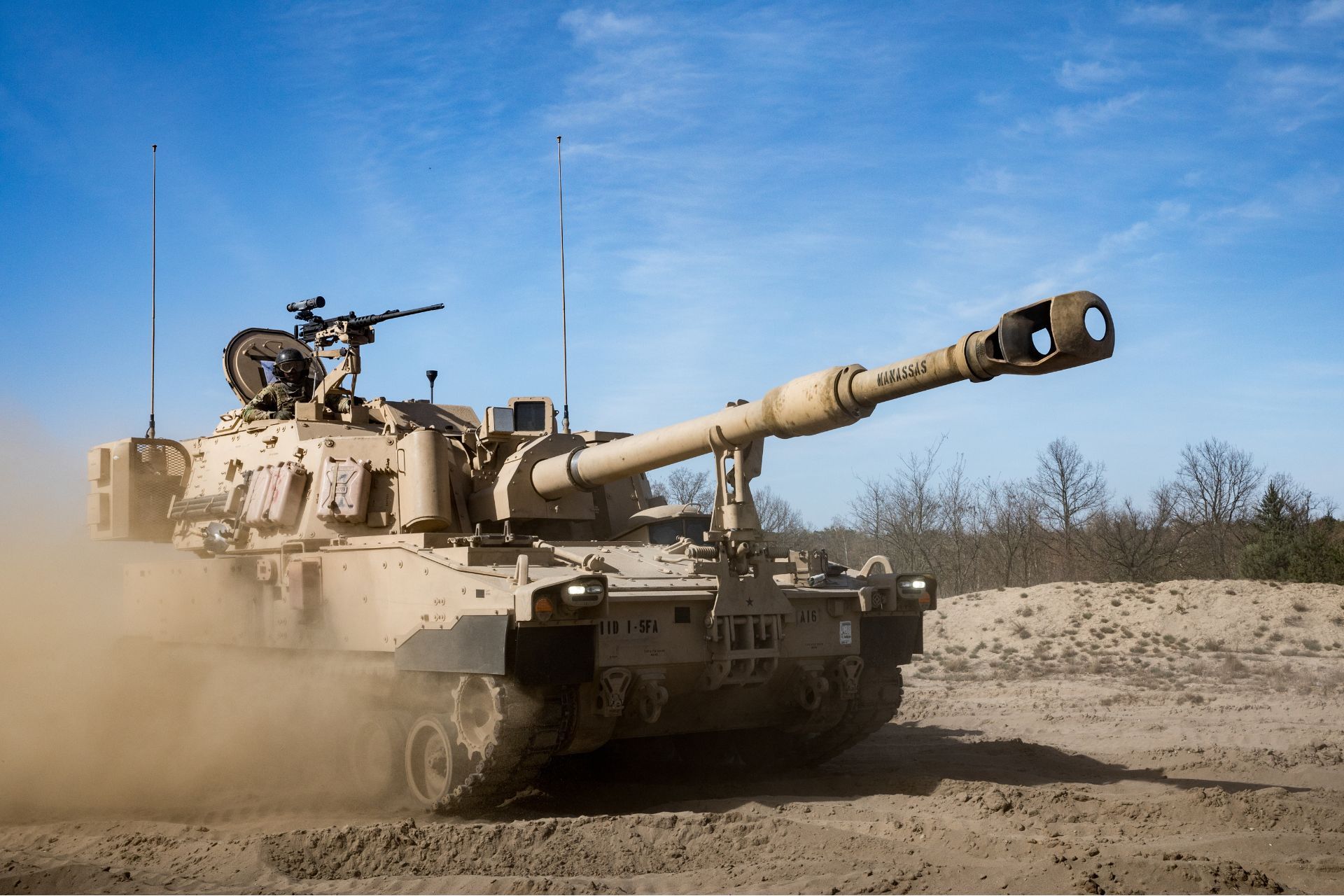
BAE Systems disclosed on 21 January 2026 that the US Army has confirmed a $473 million contract for the production of 40 additional M109A7 Paladin self-propelled howitzer sets, along with the associated M992A3 Carrier Ammunition Tracked vehicles. The award, announced through the company’s Combat Mission Systems business line and updated later the same day, reflects the Army’s continued focus on sustaining heavy artillery capability within armored brigade combat teams rather than expanding overall fleet size. Beyond new vehicle production, the contract also funds technical support packages, post-production refurbishment, and welding compliance activities, signaling an emphasis on readiness, safety, and long-term sustainment.
The M109A7 Paladin Self-Propelled Howitzer represents the most extensive redesign of the M109 family since its original introduction during the Cold War. While the weapon system retains the 155 mm cannon architecture of the M109A6, the A7 variant introduces a completely new chassis, cab, and automotive backbone. These elements are directly derived from the M2 and M3 Bradley Infantry Fighting Vehicle family, a deliberate choice aimed at increasing commonality across US Army heavy formations. By aligning engines, transmissions, suspension components, and steering systems with those already in service, the Army reduces its logistical footprint and improves sustainment in prolonged deployments.
The main armament consists of a 39-caliber 155 mm M284 cannon mounted on the M182A1 gun cradle. With conventional unassisted high explosive ammunition, effective firing ranges reach approximately 24 kilometers, extending to around 30 kilometers with rocket-assisted projectiles. The system is fully compatible with the M982 Excalibur precision-guided munition, a Global Positioning System-guided round capable of achieving accuracy reportedly within two meters under optimal conditions. This level of precision allows artillery units to engage point targets with fewer rounds, supporting commanders operating under restrictive rules of engagement or in densely populated areas.