
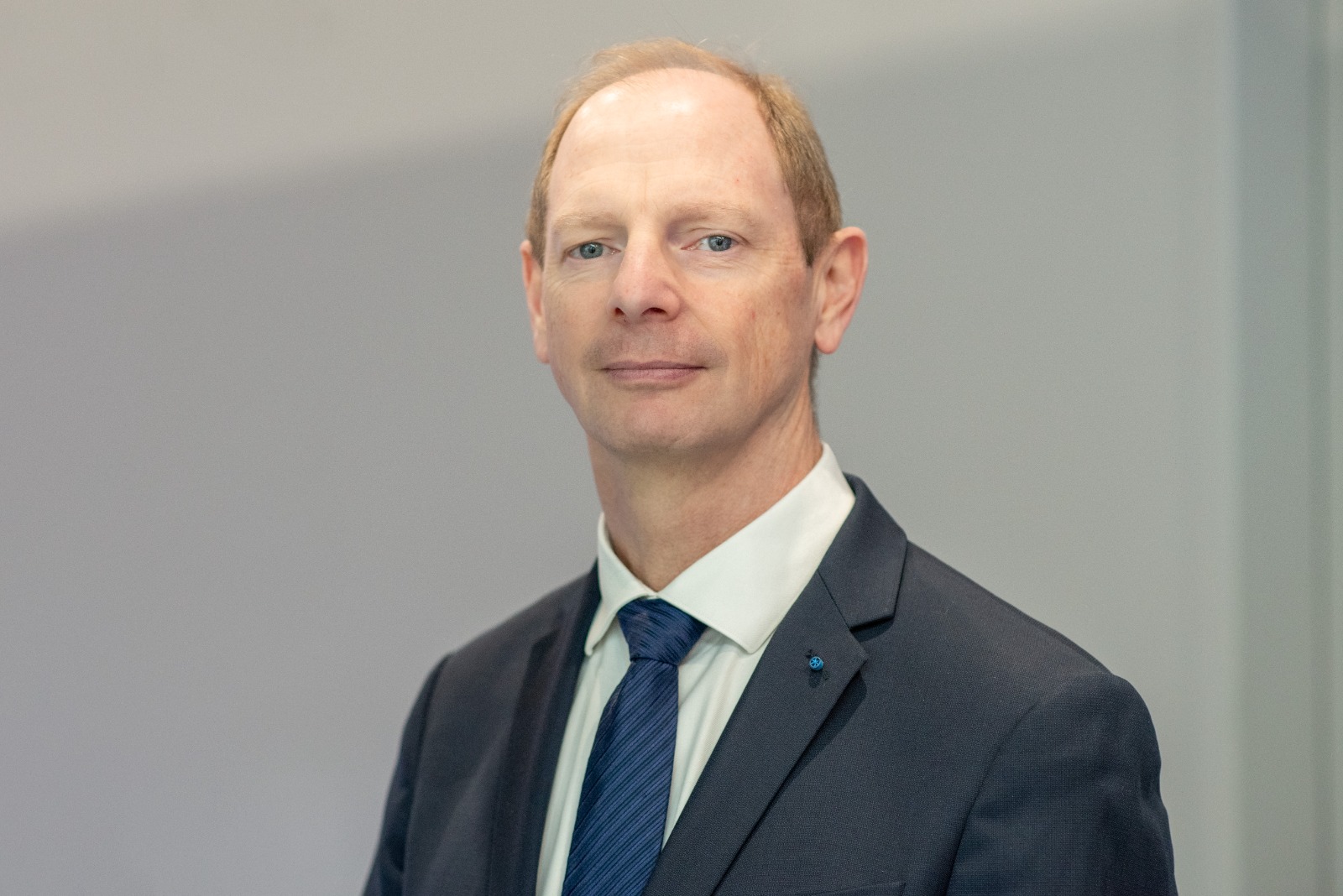
Private – Ali Omar
At UMEX–SIMTEX 2026, the region’s premier platform for unmanned systems and simulation technologies, naval autonomy and multi-domain operations took center stage. Against this backdrop, SDArabia spoke with Mr. Aymeric Moullart de Torcy, Responsible of Operational Marketing Drones & Cyber at Naval Group, to explore how unmanned surface and underwater systems are reshaping modern naval warfare, enhancing operational reach, and supporting fleet modernization in increasingly complex maritime environments. From the Seaquest S unmanned surface vessel and the Seagent XL extra-large autonomous underwater vehicle to the Steeris mission system enabling manned–unmanned teaming, Naval Group outlined its vision for autonomous naval capabilities, lessons learned from operational deployment, and its long-term commitment to the UAE and the wider Middle East through strategic partnerships, localization, and technology transfer. Here is the full interview:
– Seaquest S is a key element of Naval Group’s unmanned maritime portfolio. How does this system enhance naval operations in complex and contested maritime environments?
- Capable of operating alone, in swarms and natively embarkable on surface ships, the Seaquest® S is an autonomous multi-mission USV that extend the operational capabilities of a ship or of maritime surveillance.
- It is designed and produced by SIREHNA, a subsidiary of Naval Group, in partnership with the shipyard Couach-CNC.
- The USV has been designed in a modular manner to meet the operational needs of users.
- The Seaquest® S delivers optimal mission performance, including by constraining sea states, can operate alone or with others and offers native boarding capability on board frigates and support vessels with berths or lifting means.
- Thanks to its modular design, the Seaquest® S range will be able to be declined according to different types of operational needs such as: EW, ASM, ISR, maritime surveillance etc.
- The respective experience of SIREHNA and Chantiers Navals Couach-CNC has allowed for the design of a mature and successful product that demonstrate its reliability and suitability for operational use in a naval force.
- Seaquest S can be remotely operated or equipped with Steeris® to become an autonomous systems.
– The XL UUV represents a major step forward in large autonomous underwater systems. What types of missions is the XL UUV designed to perform, and what advantages does it bring to modern naval forces?
The Seagent® XL is an autonomous UUV that can be deployed from a dock or from a surface ship. Its long endurance and discretion allow it to operate independently in a hostile environment. The numerous payloads it carries make it a force multiplier within a fleet for offensive and defensive missions.
The Seagent XL respond to :
- The needs to benefit from additional assets dedicated to submarine warfare, with great discretion and versatility
- At the will of the navies to expand their submarine capabilities at a reasonable cost
- At the wish of the clients to be able to penetrate the underwater field
- The need to benefit from great endurance, great capacity, and a very stealthy asset
Distinctive features and performance:
The SEAGENT-XL offers flexible and extensive mission capabilities:
- Single autonomous multi-mission UUV system
- Modular architecture allowing integration of various payload batches, variable for subsea and surface missions
- Equipped with Steeris® for interoperability with naval forces
- Mission versatility: ISR, EO/IR, environmental assessment, electronic warfare, anti-submarine warfare, sea bed warfare, extended MCM, mobile target.
- Cybersecured
- Easy launch and recovery from coastal and surface vessels (containerized version)
- Easy to carry using an ISO shipping container
– Steeris is presented as a mission system that enables coordination between manned and unmanned platforms. How does Steeris improve command, control, and mission management in multi-domain naval operations?
- Steeris is designed for long-endurance, multi-mission combat drones without the need for teleoperation.
- These autonomous systems are capable of implementing a military tactical reasoning under the constraint of use doctrine to execute their mission. It operates on an ability to constantly replan its mission based on the stimuli it receives from outside.
- They are permanently under the supervision of a human operator who remains the sole decision-maker regarding the engagement of weapons. For the critical phases of the mission, it can follow in real time the projection of the vehicle’s behavior thanks to a digital twin of the drone.
- The system integrates AI capabilities of different types according to the functions. We are working in particular on explainability to give sailors full confidence in these capabilities.
- This system allows autonomous systems to accomplish their missions alone or in collaboration while respecting the doctrine of use.
The operational contribution of Steeris is threefold: low workload for the operator, complete confidence in compliance with the doctrine thanks to on-board software supervision and system cyber security, and finally an interfacing solution to the mission system.
Steeris replicates the operating mode of a manned ship. The commander of a naval force gives high-level orders to a unit which then proposes a mission sequence and executes it with certain degrees of freedom. The software architecture itself is close to a crew structure.
Steeris guarantees sailors respect for the orders of the human operator in the objectives of the mission, in the rules of behavior and the degrees of freedom left to the autonomous system. An independent hypervisor system is in a position to fully stop the mission in case of non-compliance with the doctrine.
– From an operational perspective, how do unmanned surface and underwater systems change naval concepts of operation, and what lessons has Naval Group learned from testing or deploying these systems?
Drones provide a capability boost for navies, deployable easily and at a lower cost.
Naval Group is convinced that the integration of naval drone systems is a key factor in the modernization of naval fleets. The use of such drones extends the range and duration of missions, reduces risks for crews, offers cost and efficiency advantages, and contributes to a continuous innovation process to meet the specific needs of navies.
– UMEX and SIMTEX highlight the growing importance of unmanned systems in the region. What is Naval Group’s long-term vision for the UAE and the Middle East in terms of naval capabilities, partnerships, and local industrial cooperation?
Naval Group has a strong commitment in the UAE where it is established since 2010 with the objective of developing sustainable, long-term partnerships which contribute to national sovereignty.
Naval Group already has a successful experience with the UAE Navy for the design and construction of 2 Gowind corvettes ordered in 2019 and equipped with Naval Group’s MU 90 light-weight torpedo, ordered by the UAE Navy in 2022. The first corvette was delivered on 21 October 2023 in Lorient and the second on 27 June 2024.
The company wishes to reinforce its partnership with the UAE naval defense ecosystem and its participation in naval defense projects launched by the UAE Navy to enhance the country’s sovereignty at sea and contribute to the protection of its strategic interests by delivering the best technologies, driven by innovation and R&D investments. We are keen to offer the latest technologies to ensure self-reliance of the UAE Navy.
Localization is a key driver of Naval Group’s strategy in the Middle East, one that fully aligns with the ambitious visions of this region for defense independence and industrial growth. We work at developing long-term partnerships that empower local industries, job creation, and facilitate the transfer of critical knowledge and technology. In the UAE, we have been able to contribute to localization through various initiatives such as the Gowind program, which involved extensive local participation and underlined our ability to build technological partnerships with company like the EDGE Group.
Naval Group seeks to reinforce its partnership with the UAE naval defense ecosystem and its participation in naval defense projects launched by the UAE Navy. To that extend, Naval Group has a consistent and promising roadmap of strategic industrial capacities to be implemented with various industrial partners in Abu Dhabi, proposing an ambitious focus on high added value transfers of technology and common research and development programs with UAE key players.
The agreement on the NCMS program comes as part of Naval Group’s commitment to supporting the UAE’s ambition to enhance its defense and security industries, support the sector’s rapid growth and provide national defense solutions capable of meeting future needs. Naval Group will deliver a full capacity to the UAE Navy through a Transfer of technology and Transfer of Know-How in the domain of combat management system. The UAE Navy will thus be able to operate a national CMS that will be integrated in their naval fleet, for both newbuild and retrofit ship programs.
Naval Group has also joined forces with the country’s leading university, Khalifa University, to collaborate on innovative research fields to support UAE’s naval industry. A MoU was signed in February 2023. Two cooperation programs are currently being studied: one on additive manufacturing and the other on the Energy Grid.